>

Channel Islands National Park Information Page

Welcome to the Channel Islands National Park Information Page.
Here you will find all you need to know about the natural history of the park.
Learn about the geology, trees, mammals, birds, or other plants and wildlife of the area.
-SPONSORED LINKS-
Channel Islands Lodging
Channel Islands Hotels
Channel Islands Maps
Channel Islands Camping
Channel Islands Weather
Channel Islands Vacation Rentals
Elephant Seal

Sponsored National Park Search

Elephant Seal - Corel ©

Channel Islands National Park Information

  • Anacapa Island
  • Brown Pelican
  • Ecology
  • Establishment
  • History
  • Island Fox
  • Intertidal Plants and Animals
  • Northern Elephant Seal
  • Pygmy Mammoth
  • San Miguel Island
  • Santa Barbara Island
  • Santa Cruz Island
  • Santa Rosa Island
  • Size and Visitation
  • Tidepool Tips

  • 
    

    Establishment

    The Channel Islands, an island chain lying just off California's southern coast, appear quite close on clear days. Five of the eight islands and their surrounding one nautical mile of ocean, with its kelp forests. comprise Channel Islands National Park.

    In 1980, Congress designated Anacapa, San Miguel, Santa Barbara, Santa Cruz and Santa Rosa Islands and 125,000 acres of submerged lands as a national park because they possess unique natural and cultural resources.

    A series of Federal and landowner actions have helped preserve these nationally significant island treasures. Federal efforts began in 1938 when President Franklin D. Roosevelt proclaimed the islands of Anacapa and Santa Barbara a national monument. In 1976 a U.S. Navy and National Park Service agreement allowed supervised visitation of San Miguel Island. In 1978 a conservation partnership between the Nature Conservancy, a national nonprofit conservation organization, and the Santa Cruz Island Company provided for continued protection, research, and educational use of most of privately owned Santa Cruz. Finally on March 05, 1980, President Jimmy Carter signed into law a bill abolishing Channel Islands National Monument. He then raised the status of these islands, with the addition of the waters surrounding Santa Cruz and Santa Rosa to that of a national park. This area was augmented by the designation of Channel Islands National Marine Sanctuary later that year. The sanctuary boundaries stretched six miles offshore, encircling Santa Barbara and the four northern islands, including their interconnecting channels. Today, Channel Islands National Park is part of the International Man and the Biosphere program to conserve genetic diversity and an environmental baseline for research and monitoring throughout the world.


    Size and Visitation

    The park consists of 249,354 acres, half of which are under the ocean, and include the islands of San Miguel, Santa Rosa, Santa Cruz, Anacapa, and Santa Barbara. Even though the islands seem tantalizingly close to the densely populated, southern California coast, their isolation has left them relatively undeveloped, making them an exciting place for visitors to explore.

    Annual visitation to the park's mainland visitor center is 300,000. Visitation to the islands and waters is low, with about 30,000 visitors traveling to the islands, and another 60,000 who go only into park waters. Although most visitation occurs in the summer, migrating gray whales and spectacular wildflower displays attract visitors in the winter and spring. Autumn is an excellent time to travel to the park, as well as for diving, as the days are usually sunny, with minimal winds and clear ocean water.


    History

    Archeological and cultural resources span a period of more than 10,000 years. First came the seafaring Indians; then the explorers, fur traders, adventurers, and settlers; finally the scientists and sightseers of today.

    Seafaring Indians plied the Santa Barbara Channel in swift, seaworthy canoes called "tomols". The Chumash or "island people" had villages on the northern islands and traded with the mainland Indians. The Gabrielino people lived on the southern island of Santa Barbara.

    1542 found the explorer Juan Rodriguez Cabrillo entering the Santa Barbara Channel. Cabrillo, commanding an expedition in service of Spain, was the first European to land on the islands. While on his northbound odyssey of exploration, Cabrillo wintered on an island he called San Lucas (San Miguel or possibly Santa Rosa Island). He died as a result of a fall on that island and may have been buried on one of the Channel Islands, but his grave has never been found. Subsequent explorers included Sebastian Vizacaino, Gaspar de Portola and English Captain George Vancouver, who in 1793, fixed the present names of the islands on nautical charts.

    Beginning in late 1700s and into the 1800s, Russian, British and American fur traders searched the islands' coves and shorelines for sea otter. The otter was almost hunted to extinction. The hunters then turned toward the seals and sea lions. Several of these species faced extinction as well.

    In the early 1800s, the Chumash and Gabrielino people were removed from the islands and settled in mainland missions. Hunters, settlers and ranchers soon came to the islands. By the mid-1800s, except for fishermen, ranching became the economic mainstay.

    In the early 1900s, the US Lighthouse Service (later the US Cost Guard) began its stay on Anacapa Island. The US Navy took control over the Island of San Miguel just before World War II.

    Channel Islands National Park is home to a wide variety of nationally and internationally significant natural and cultural resources. Over 2,000 species of plants and animals can be found within the park. However only four mammals are endemic to the islands. One hundred and forty-five of these species are unique to the islands and found nowhere else in the world. Marine life ranges from microscopic plankton to the endangered blue whale, the largest animal to live on earth.


    Island life and Ecology

    For many plants and animals of the Channel Islands, life is not possible without both the land and the sea. Pelicans fish for anchovies from the ocean but nest on the dry bluffs of West Anacapa. Low growing sand verbena needs the sandy soil of San Miguel Island to grow, but it also needs salt from the ocean air. Giant kelp fastens its root like hold on the shallow rocks of islands nearshore reefs, yet this seaweed also needs nutrients from the deep ocean.

    Isolated from the mainland and the mingling of warm and cold water currents in the Santa Barbara Channel help form the Channel Islands special character. The plants and animals are similar to those on the mainland but thousands of years of isolation in unique island environments have resulted in size, shape or color variations. The Channel Islands are home to 65 plant species that do not exist anywhere else in the world. All of the larger islands are home for the island fox, a close relative to the mainland's gray fox. Because it evolved in isolation, the islands fox is no larger than a house cat. These foxes prey upon deer mice that are slightly larger than their mainland relatives. Both creatures are well adapted to the harsh island environment.

    Remoteness from the mainland has buffered the island from the rapid changes wrought by modern humans.While most mainland tidepools are practically devoid of life because of heavy human use, sea stars, sea urchins, sea anemones and limpets thrive in the islands intertidal areas. White plumed sea anemones still cover underwater rocks at San Miguel and vivid purple hydrocorals filter water for food near Santa Cruz Island. Though used by fishermen and sport divers, and subject to mainland water polluntants, the kelp forests of the Channel Islands harbor great numbers of plants and animals. Today the islands support some of the last remnents of coastal southern California plant communities rapidly disappearing from the mainland.

    During the last Ice Age, the northern Channel Islands were part of one vast island geologists called Santarosae. Sea levels were much lowere and large areas of today's sea bed were dry. The northern islands were linked together, though probably not connected to the mainland. When the continental ice sheets melted, rising water seperated the islands.

    During the Pleisocene era, a dwarf species of mammals roamed Santarosae, and pine and cypress forests stood on several islands. Today, fossilized remains of dwarf mammoths on San Miguel and Santa Rosa, and the forests of brittle sand castings, known as caliche (pronounced kah-lee-chee) that are found on San Miguel remind us that the islands were very different long ago. Some plants and animals developed special adaptations over time to cope with the isolated environment, others remained unchanged. The giant coreopsis is found on all five park islands and on the coastal mainland. Its common name, tree sunflower, suggests its size and trunck like stem. Its bright yellow blossoms are sometimes visible from the mainland during the winter and spring.

    The introduction on non native plants and animals to an island ecosystem can devastate native species. One exotic is a tenacious South African species of iceplant that found its way to Santa Barbara Island before 1900. Highly salt tolerant, it thrives in arid soil by capturing moisture from sea breezes. It subsequently leaches salt into the soil, producing concentrations of salt that few native plants can tolerate. Today, the iceplant spreads its thick mats over much of the island. Introduced livestock, food animals, and pets have similar impacts on island environments. Escalating feral sheep, hog, cat, and rabbit populations led to damage to, and sometimes elimination of, native plants and animals. The National Park Service seeks to restore native populations where possible.


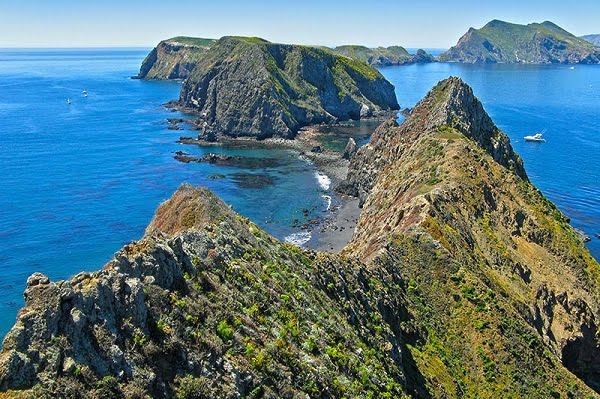
    Anacapa Island (699 acres)

    Anacapa lies 11 miles southwest of Oxnard and 14 miles off the coast from Ventura. Almost five miles long, its total land area is about one square miles. Anacapa is composed of three small islets inaccessible from each other except by boat. For much of the year the island vegetation looks brown. With winter rains, the plants emerge from summer's dormancy and turn green. Sea mammals are often seen around Anacapa's shores. January through March is gray whale watch season, and migrating whales can be seen swimming along their 10,000 mile migration route. Western gulls, cormorants, black oystercatchers, and endangered California brown pelicans may be seen year round. West Anacapa's slopes are the primary West Coast nesting site for the brown pelican. To protect the pelican rookery, West Anacapa's is a Research Natural Area closed to the public. Except at Frenchys Cove, no landings are permitted on West Anacapa without written permission from the park superintendent.

    Anacapa is the only Channel Island to retain its American Indian name, derived from the Chumash word, "Eneepah", meaning island of deception or mirage. Ocean waves have eroded the perimeter of the island, creating steep sea cliffs towering hundreds of feet in height and exposing the volcanic origins of air pockets, lava tubes, and sea caves. At the east end of Anacapa a natural bridge has formed in the ocean. Forty-foot high Arch Rock is a trademark of Anacapa and Channel Islands National Park.The facilities on Anacapa overlook the northern channel.


    San Miguel Island (9,325 acres)

    Wind and weather sweep across the North Pacific to batter the shores of the westernmost of all the islands. This creates a harsh and profoundly beautiful environment. San Miguel is about eight miles long and four miles wide. It is primarily a plateau about 500 feet in elevation, to two 800 foot rounded hills emerge from its wild, windswept landscape.

    San Miguel boast outstanding natural and cultural features. Some of the Channel Islands' best examples of caliche are found here. One of the most spectacular wildlife displays in the park is viewing the thousands of seals and sea lions that breed on its isolated shores. The Channel Islands' largest land mammal, the island fox, can be seen on San Miguel. The island's fragile treasures include more than 500 relatively undisturbed archeological sites, some dating back as far as 11,000 years. Juan Rodriguez Cabrillo, discoverer of California, is believed to have wintered and died at Cuyler Harbor in 1543. Although his grave has never been found, a monument overlooking Cuyler Harbor was erected in 1937 to commemorate his northern voyage of exploration.

    In the 1850s, Captain George Nidever brought sheep, cattle and horses to San Miguel. An adobe be built may be the earliest structure on any of the Channel Islands. Its remains are barely visible today. In 1930, Herbert and Elizabeth Lester became the island's caretakers. The family left the island in 1942 after the suicide of Herbert Lester, who had become known as the "King of San Miguel." From the mid-1940s to the mid-1950s the island was used as a bombing range. Staying of the trail is particularly important because live ordnance is still occasionally uncovered by shifting sands

    San Miguel has a primitive campground, miles of hiking trails, and beaches and offers Ranger-led hikes, marine-mammal observation, beach exploration, and bird watching. Fifty-five miles off the coast from Ventura, San Miguel Island is the farthest west of the Channel Islands. Because of its location in the open ocean, it is subject to high winds and lots of fog. The island is a tableland of lush grasses and wildflowers, with 27 miles of jagged, rocky coastline dotted with sandy white beaches. The westernmost of these beaches, Point Bennett, is the only place in the world where up to six different species of pinnipeds (seals and sea lions) can be found.


    Santa Barbara Island (639 acres)

    Santa Barbara Island lies far south of the other park islands. Smaller, about one square mile, and triangular, its steep cliffs rise to a marine terrace topped by two peaks. The highest point, Signal Peak, is 635 feet in elevation.

    Santa Barbara Island was named by Sebastian Vizcaina, who arrived here on 04 December 1602. This date is known as Santa Barbara's Day. Because of the lack of fresh water, Native Americans did not reside on the island, but they stopped off on journeys to other islands. Not until the 20th century was Santa Barbara Island settled to any extent. During the 1920s, farming, grazing, intentional burning by island residents and the introduction of rabbits severely damaged the native vegetation. During World War II the U.S. Navy used the island as an early warning outpost. Through non-native grasses including oats, barley, and brome dominate the landscape, with protection and encouragement the native vegetation is recovering. With the rabbits now removed, stands of giant coreopsis thrive. In places this sunflower grows up to ten feet tall. In the spring, gold fields blanket the island with tiny, bright yellow flowers.

    California sea lions and, in winter, elephant seals breed here. Bird watching is superb. Western gulls, xantus murrelets and brown pelicans nest on the island plateaus and cliffs. Land birds, including barn owls, American kestrels, horned tarks and meadowlarks nest here. Although not commonly seen, the island deer mouse and the island night lizard, a threatened species, live on the island.

    Santa Barbara Island offers 5.5 miles of trails to explore. A good place to start is the Canyon View self guiding nature trail near the ranger station and campground. A trail booklet explains the island's interesting features. A park ranger stationed on the island interprets its features and enforces rules and regulations. There is no telephone, but in emergencies the ranger has radio communications with park headquarters.


    Santa Cruz Island (60,645 acres)

    Largest and most diverse of the islands within the park, Santa Cruz Island is about 24 miles long is 19 miles from Ventura. Its land area is about 96 square miles. The central valley's north slope is a rugged ridge; the south slope is an older, more weathered ridge. At 2,470 feet, the highest of the Channel Islands mountains is found here. Santa Cruz Island's 77 mile varied coastline has steep cliffs, gigantic sea caves, and coves and sandy beaches. The shoreline cliffs, beaches, offshore rocks, and tidepools provide important breeding habitat for colonies of nesting sea birds and diverse plants and animals. The varied topography and ample freshwater support a remarkable array of flora and fauna--more than 600 plant species, 140 land bird species, and a small, distinctive group of other land animals.

    Of the 85 plant species native to the Channel Islands, nine occur only on Santa Cruz. The Santa Cruz Island ironwood, the island oak, the island fox, scrub, jay and other distinctive plant and animal species have adapted to the island's unique environment. To biologists, Santa Cruz is specifically significant for its diversity of habitat, greater than any other of the Channel Islands.

    Chumash Indians inhabitated Santa Cruz Island for more that 6,000 years. When Juan Rodriguez Cabrillo arrived in 1542, as many as 2,000 Chumash Indians probably lived here.

    Ranching began on the island in 1839, with a Mexican land grant to Andres Castillero, and continued to the early 1980s.

    In 1988 the Nature Conservancy acquired the western 90 percent of the island. The National Park Service owns the eastern 10%, where visitors may observe wildlife, hike, camp and explore the newest addition to the park. Santa Cruz Island, the largest of the Channel Islands. It is an island of great scenic beauty with diverse land forms--two rugged mountain ranges, deep canyons, a wide central valley, year-round springs and streams, giant sea caves, 77 miles of craggy coastline cliffs, pristine tidepools and expansive beaches.


    Santa Rosa Island (52,794 acres)

    The second largest island is Santa Rosa. Nearly 15 miles long and 10 miles wide, its 84 square miles exhibit remarkable contrasts. Cliffs on the northeastern shore rival those of Santa Cruz Island. High mountains with deeply cut canyons give way to gentle rolling hills and flat marine terraces. Vast grasslands blanket about 85 percent of the island, yet columnar volcanic formations, extensive fossil beds, and highly colored hill slopes are visible. Rocky terraces on the west end provide superb habitat for intertidal organisms. Harbor and elephant seals breed on the island's sandy beaches. On the eastern tip of the island, a unique costal marsh is among the most extensive freshwater habitats found on any of the Channel Islands. The entire island is surrounded by expanses of kelp beds. Consequently, its surrounding waters serve as an invaluable nursery for the sea life that feeds larger marine mammals and the sea birds that breed along the coastal shores and offshore rocks of all the Channel Islands.

    Beneath Santa Rosa's non-native grasslands are the remains of a rich cultural heritage. More than 600 archeological sites have been mapped. These include several associated with early human presence in North America. Chumash Indian villages and camps of early explorers and fun hunters are evident.

    In the 1840s and 1850s, Santa Rosa was a cattle rancheria. After the cattle industry of old Spanish California collapsed in the 1860s, sheep were brought to Santa Rosa and soon became its economic mainstay. Sheep grazing continued into the early 1900s, but when the island was sold to Vail & Vickers Company in 1902, the sheep were removed and cattle reintroduced. Though the impacts of introduced grains, insects, sheep, pigs, deer, elk and cattle were severe, examples of Santa Rosa's native plant communities survive. These tend to be restricted to rocky canyons and upper slopes. Native plants include the tree poppy, island manzanita, and endemic sage. Native Island Oaks grow on protected slopes, and two groves of Torrey pine are visible near Bechers Bay.

    More than 195 bird species are found on Santa Rosa. With its extensive grasslands, the island supports large populations of European starlings, horned-larks, meadow larks, house finches and song sparrows. Shore birds and waterfowl favor the brackish habitat found on Santa Rosa's eastern tip. This marsh and the island's running streams provide habitat for tree frogs and Pacific slender salamanders.

    Other terrestrial animals include the gopher snake, deer mouse, and two species of lizard. The island fox may be frequently seen. The endemic spotted skunk--found only on Santa Rosa and Santa Cruz Islands--is only rarely observed. Among the islands extinct terrestrial mammals is the pygmy mammoth.


    Brown Pelican

    On the West coast of North America, Brown Pelican (Pelicanus occidentalis) colonies are located on West Anacapa Island, Santa Barbara Island and on islands off the coast of Baja California. Therefore the only breeding colonies of Brown Pelican in the western US. are supported by the Channel Islands. These colonies almost disappeared in the 1970's .

    Alarmed at the decline, biologists began visiting West Anacapa Island (WAI) in 1969 to document the population and determine why the breeding effort by Brown Pelicans had radically decreased. They found the few eggs that were being laid were unlikely to survive to hatching because of reduced eggshell thicknesses.

    Brown Pelicans use their highly vascularized feet to incubate the eggs by standing on them. Eggshell thinning obviously makes the eggs more fragile and more likely to crack or break when a 9 pound bird stands on them, however delicately so.

    Research projects carried out by University of California, Davis staff and students revealed the presence of high levels of DDT/DDE in the marine environment. And thus the direct link to egg-shell thinning was made.

    The number of birds in the breeding population has steadily increased to 4000-6000 nesting attempts every year at West Anacapa Island. This is in sharp contrast to the early 70's in which there were only about 100 nest attempts. On Santa Barbara Island, the once ephemeral colony produces 400-700 nests every year.

    Management actions taken include restricting access to West Anacapa Island. A closure keeping boats well offshore was created to protect fledglings in the vicinity of the nesting colony.

    In 1986, UC Davis researchers worked together with Park Service scientists to standardize monitoring protocols for Brown Pelicans as part of the National Park's Seabird Monitoring Program. Monitoring involves viewing the nesting sites once a month for the duration of the nesting season which can extend from January-September. Counts of adults, nests, and chicks provide information on nesting effort. Determining broodsizes and aging individual chicks lead to an estimate of fledging success and, therefore, reproductive success of the adults.

    Difficult access to West Anacapa and the increasing population is forcing us to look at new monitoring methods. The new methods include using a variety of aerial photography formats.

    Brown Pelicans became Federally protected under the Endangered Species Act in 1972. While breeding attempts appear to have leveled out there are still many reasons for concern regarding the Brown Pelicans. Human disturbance and pollution remain large threats to these birds.


    Northern Elephant Seal

    Four species of pinnipeds, or "fin-footed" animals, are known to frequent Channel Islands National Park: northern fur seals, harbor seals, California sea lions, and northern elephant seals. During various times of year, around 50,000 giant elephant seals seek the isolation of the islands to haul-out, breed and molt. Most of them prefer remote Point Bennett, on the far western tip of San Miguel Island--truly one of the park’s greatest natural wonders. Smaller colonies can be seen on Santa Barbara and Santa Rosa Islands. But they are often heard before any sighting, their deep rumblings rolling like thunder across the landscape.

    More species are sighted at Point Bennett than at anywhere else on the planet. The sea lion family is well represented by California sea lions, Steller's or northern sea lions, northern fur seals, and Guadalupe fur seals. True seals include the harbor seal and of course the elephant seal.

    Why do all these seals and sea lions spend time at Point Bennett? Isolation from people is surely one reason. For years seals and sea lions were hunted for their oil and skins. But Point Bennett has always been a gathering place for pinnipeds. The spot provides all the necessary ingredients that the seals and sea lions need to have their young, wide sandy beaches, plenty of food, and others of their kind. For most of the year many of the individuals are scattered over a wide area. They come together each year at Point Bennett to breed, give birth and sometimes to molt.

    Incredibly, 80% of an elephant seal’s life is spent alone at sea, where they feed on squid, octopus, fish, rays, small sharks and invertebrates. Their twice-annual migrations can encompass 13,000 miles, the longest of any mammal. Often diving up to a mile deep (also a mammal record), they can hold their breath for up to two hours! Their mass of blubber provides all the protection they need from the great cold and pressure of the depths as they search for sustenance. Only great white sharks and orcas dare to seek this behemoth as food.

    A massive creature, the male (or "bull") seen here can grow to 20 feet in length and weigh up to 4 tons—the largest of all seals! Only the bull exhibits the trunk, or "proboscis," from which its name derives. During the December-to-April breeding season, spectacular battles may erupt between competing bulls, with heavy scarring seen as their medals of valor. Forsaking food during this period, the males may lose up to 30% of their body weight.

    Conceived during the previous season, pups are born shortly after the females arrive in early December. Tiny by comparison at a mere 65-90 pounds, they nurse for a month on rich mother’s milk, growing to about 300 pounds. Twenty days after giving birth, the female (or "cow") enters a 4-day breeding period. This is the only time of year she will mate. Between fasting and nursing for the previous month, females lose up to 40% of their body weight.

    Hunted nearly to extinction in the 1800’s—for the oil in their blubber--the elephant seal continues to expand its home territory. The remaining 1000 or so that managed to survive on small Guadalupe Island, off the coast of Mexico, have expanded to more than 125,000 animals today in a number of colonies. Along the California coast, they can now be seen at San Simeon State Beach, Ano Nuevo State Park and Point Reyes National Seashore, plus many offshore islands. As their numbers increase, further colonies will be established---a continuing success story in the recovery of this magnificent and curious mammal.

    Diversity

    To explain the diversity of the species at Point Bennett, we need to look at the bigger picture. San Miguel Island lies in an area of water that overlaps two currents, a cold current moving down the Pacific ciast from Alaska and a warm current moving up from the Pacific coast from Mexico. Those two currents meet and intermingle not only water, but many of the species associated with corresponding cold and warm currents. Islands also bring diversity by providing shelf areas where sunlight can penetrate the water, and plants such as the giant bladder kelp can grow. The dense kelp forests around the islands provide food and shelter for many varieties of plants and animals.

    Finally, upwelling conditions exist near San Miguel Islands. Upwelling sucks cold nutrient rich water that normally lies at the bottom of the ocean to the surface, providing for hundreds of species. The diversity of seals and sea lions at Point Bennett is an excellent example of the biological diversity found in the Santa Barbara Channel. Stellar's sea lions visiting from the cold waters of the north, Guadalupe fur seals traveling in the warm waters of the south, elephant seals feeding on the squid abundant in the deep waters and California sea lions eating the huge variety of fish available in the channel. All are animals getting what they need to survive in the diversity of the area.

    Protection

    These animals are protected by spending at least part of their lives in a national park, or are they? Some threats to these animals know no boundaries. Threats made by water pollution, plastics, and debris in the ocean, oil spills, overharvesting of fisheries, toxins and pesticides affect even the isolated areas like Point Bennett. These threats can also affect people. Without protection, the spectacular rituals performed on the beaches of Point Bennett can become a thing of the past. Generations to come may only experience the grandeur of Point Bennett through stories and photographs.

    Peopel can make sure that the pinnipeds of Channel Islands National Park survive into the future. Simple things like recycling plastics can make a difference to a curious young sea lion looking for something to play with. The plaything does not need to be a piece of plastic webbing that may strangle it.

    The most important action that people can take is to visit Point Bennett. Discover the world of pinnipeds for yourself and then tell others how important it is to keep the rituals continuing.


    Island Fox

    There are eight Channel Islands off the coast of Southern California. Six islands, (San Miguel, Santa Cruz, Santa Catalina, San Nicolas, and San Clemente) comprise the only place in the world that is home to the island fox, Urocyon litteralis. The island fox is considered closely related to the mainland gray fox, Urocyon cinereoargenteus.

    Island foxes average in size from 12 to 13 inches in height, 590 to 700 mm in length, and three to four pounds in weight. This size is up to 18 percent smaller than the nearby mainland gray fox. Similar in appearence to the gray fox, the island fox is identified by a gray coloring on the back, reddish brown coloring on the sides, and white undersides. There are distinctive black, white and rufous markings on the face. Island foxes tend to have a more rufous coloring and have two less tail vertebrae than the gray fox.

    The average litter sixe is two and pupping is usually in May or June. Mating takes place in February and March, and the males play only a small role in the raising of the young. Unlike gray foxes, island are frequently active during the daylight hours and their diet consists of up to 70 percent fruit and plant material. Another 20 percent of their diet is made up of insects and the remainder is made up of small rodents such as deer mice.

    Geologists believe that the Channel Islands were not connected to the mainland during the last ice age (Pleistocene), when the ocean levels were much lower than today. The fossil record shows evidence of foxes on Santa Rosa Island dating back 10,400 to 16,000 years ago. How did the fox cross a water barrier? The most plausible theory is one of rafting. As the ocean levels lowered and the distance between the mainland and the northern islands shrank, the islands became one large island called Santarosae. The gray fox could have rafted to the large island propelled by a storm and or currents. The foxes adapted to their island hoime, evolving into a dwarf or smaller form of gray fox.

    Environmental and ecological factors such as overcrowding, reduction in predators, food limitations and genetic factors could have contributed to the natural selection for a smaller size. As the climate warmed, and ocean levels began to rise, Santarosae became the islands of San Miguel, Santa Rosa, Santa Cruz and Anacapa. Because of the lack of fresh water source, the island fox died out on Anacapa, but the other three islands had all the requirements for foxes.

    Evidence of Native Americans have been found on the Channel Islands dating back at least 10,000 years. Well developed trade routes existed between the Chumash on the northern Channel Islands and the Gabrielino on the southern islands. Island foxes probably colonized the southern Channel Islands of Santa Catalina, San Nicolas and San Clemente through trade by these island people. The island fox may have colonized San Clemente Island only 500 years ago. The Chumash gave special status to the fox and it may have been considered a dream helper. The island Chumash preformed a fox dance and probably used the pelts of island foxes to make articles such as arrow quivers, capes and head dresses.

    Today the island fox is a subject of great scientific interest. Scientist can learn more about how animals evolve, effects of alien animals on native animals, and animal behavior by studying the island fox.

    The island fox is listed as threatened on the State Endangered Species List. The population of island foxes on San Miguel Island is 420 to 500 animals. The Chumash considered the fox to be a pet of the Sun.

    Further information on the island fox can be obtained by contacting:

    Channel Islands National Park
    1901 Spinnaker Drive
    Ventura, CA 93001
    Phone: 805-658-5730

    or

    Santa Barbara Museum of National History
    2559 Puesta del Sol Road
    Santa Barbara, CA 93105 Phone: 805-682-4711


    Pygmy Mammoth

    A nearly complete pygmy mammoth (Mammuthus exilis) fossil skeleton, found in 1994 excavated from a dune, is providing new insight into this poorly known animal, which lived during the Pleistocene. Radiocarbon dating shows this animal lived almost 13,000 years ago.

    The northern Channel Islands of Santa Cruz, Santa Rosa, and San Miguel were the home of the Pygmy Mammoth (Mammuthus exilis),a population of small animals that developed on the islands from full sized ancestors, most likely Mammuthus columbi, which swam across the Santa Barbara Channel sometime during the Pleistocene; the crossing might well have occurred about 20,000 years ago when sea level was lowest.

    At that time the three islands, together with Anacapa Island, were joined in a land mass known as Santa Rosae, a land mass about four times the size of present day Santa Rosa Island (52,794 acres, 213 qkm). This large land mass was then only about five miles (8 km) distant from the mainland.

    These animals stood about four to eight feet (120-240 cm) high at the shoulder, compared to their full size ancestors, which reached as high as fourteen feet (425 cm).

    Pygmy populations derived from elephants or mammoths are known from several locations throughout the world, including the islands of Malta and Sicily in the Mediterranean, several islands in southeast Asia, and Wrangell Island in the Arctic. Mammuthus exilis is the only example known from the New World, and all previous descriptions of the animal were based on isolated bones recovered from the park islands. The discovery of a complete skeleton promised greatly increased understanding of this isolated species, as well as important insights into speciation in an island environment.

    Excavation revealed a complete skeleton missing only the right tusk, one foot, and a minor portion of the skull. The small bones of both right feet were in complete articulation. Excavation uncovered the hyoid bone and sternum, the first ever recovered from this species, in life position.

    Standing five and one half feet (170 cm) tall and weighing about one ton, the animal is a male, about fifty-seven years old (relative to African elephant years), with pronounced arthritic spurs in his feet. He had been walking along the coast on the north shore of the island when he laid down, fell over on his left side, and died nearly 13,000 years ago. The animal was then quickly covered by a sand dune while his skin was still intact, accounting for the excellent articulation of the bones. This was written by the Parks Archaeologist Don Morris


    Intertidal Plants and Animals

    The following is a list and description of some of the plants and animals commonly found in the intertidal zone


    Tidepool Tips

    The area between the land and the sea is not distinct, but is a zone of transition. This are may be covered with water during high tide or exposed to sunlight during low tide. Life in this intertidal region must be hardiest within the marine environment, able to withstand hours of exposure and the incessant pounding of the energy filled surf.

    Intertidal life has adapted to the sea and the land. When looking at a tidepool area notice how plants and animals may be found in certain areas and not in others. Those living in the upper splash zone are tolerent to sunlight, heat and water loss, and have either a means in which to "shelter" themselves or the ability to move into an area of greater moisture. An animal with a tightly closed shell or a shell firmly attached to rock will hold water within so that it does not require water surrounding it at all times. Animals found in rock crevices and submerged pools usually require more moisture to prevent them from drying out.

    How an animal feeds often depends on its ability to move. An animal that moves about is able to search for its food. Some graze the rocks for algae, while others feed on settled debris. An animal that remains stationary feeds on food particles suspended within water.

    Because space is a limiting factor, there is competition between organisms. Many animals and plants are found in a small area, some may live on each other, or use an old shell as a surface on which to live. This is one important reason why collecting is not permitted, you may be taking away a home.

    Although hardy against forces of nature, the plants and animals of the intertidal zone cannot entirely endure the impact with man. Since individual interact with one another, minute changes in this area could disrupt the entire area.

    While exploring, keep in mind the following tidepool tips.


    Channel Islands National Park Links
    Bullet Activity & Calendar Page
    Bullet Address, Email & Phone Guide
    Bullet Anacapa Island
    Bullet Boating Guide
    Bullet Brochures, Maps, Written Info
    Bullet Brown Pelican
    Bullet Camping Guide
    Bullet Chat
    Bullet Ecology
    Bullet Elephant Seal
    Bullet Establishment
    Bullet Fees
    Bullet Fishing
    Bullet Hiking Guide
    Bullet History
    Bullet Intertidal Plants and Animals
    Bullet Island Fox
    Bullet Jobs, SCA, Volunteer Positions
    Bullet Kayaking Guide
    Bullet Location
    Bullet Lodging Guide
    Bullet Map Guide
    Bullet Park Information
    Bullet Park Regulations
    Bullet Pet Information
    Bullet Pygmy Mammoth
    Bullet San Miguel Island
    Bullet Santa Barbara Island
    Bullet Santa Cruz Island
    Bullet Search
    Bullet Sights Guide
    Bullet Size and Visitation Info
    Bullet Tidepool Tips
    Bullet Travel Guide
    Bullet Visitors Guide
    Bullet Weather

    Channel Islands National Park
    California National Parks
    Back to National Parks
    Equip yourself for your next National Park adventure by visiting our Outdoor Gear and Equipment Store


    by John William Uhler

    Copyright © 1995 - 2007 Hillclimb Media

    This site is in no way associated with the United States Government, the Department of the Interior or the National Park Service

    Demand Media Network